Humour, Popular Culture, Trivia, Etc.
This page lists, in chronological order, various items that make fun of Kaikhosru Shapurji Sorabji and of his music (such as articles published as April Fools’ Day jokes) as well as various bits of trivia or unusual events and use of, or reference to, Sorabji’s personality or music in the arts and popular culture.
1969-70: Series of Letters to Sorabji
Between August 1969 and September 1970 Sorabji received a series of letters from different sources, but obviously penned by the same person, inviting him to make musical contributions to groups with Socialist sympathies.
- Letter signed “L. J. Pinchnep, Secretary, Socialists in Art Movement”, inviting Sorabji to give a lecture in London “on the social context of your own music”.
- Letter from “Emmanuel G. Dodin”, introducing himself as “a well[-]known writer of lyrics from America”, who had been asked by the North Kensington Labour Party to write an anthem for the Band of Socialist Youth on a text beginning with “Rise, Red Youth, and sweep the Tories / Hand and heart into the sea, / Find how glorious civil war is, / Follow Sorabji and me!” Asked if Sorabji might like to write something “in the style of the late Sir Edward Elgar”.
- Letter from “B. V. D. Humperstone” who, as a pianist and drummer, enjoyed playing Sorabji’s music. Invites him, on the basis of his “well[-]known Socialist sympathies”, to join a committee “of extremely rich left[-]wing businessmen” who had formed a Society whose main aim was to return the Labour government to power.
- Letter from “I. S. Bull”, purportedly from the BBC’s Music Department, containing a short poem entitled Silver Skates by the “distinguished American poet Herb Hofmann”, to be used to introduce “the world ice-skating finals to be televised next Spring from Alice Springs in Australia”. Asked Sorabji for a “cheerful tune, rather along the lines of a television commercial”.
- Letter from “L. C. Bradley, Secretary, The Friends of Covent Garden”, inviting Sorabji to write an opera on one of two subjects (or a combination thereof): “a fictitious revolution in Britain, based on a recent book, in which Communist forces successfully take over the country” or “an erotic fantasy based on the novel Fanny Hill” that would capitalize on the “current cult of nudity”.
1989: Marc-André Hamelin, Praeambulum to an Imaginary Piano Symphony
From 23 to 26 January 1989, the pianist Marc-André Hamelin wrote a Praeambulum to an Imaginary Piano Symphony: Homage to Kaikhosru Shapurji Sorabji (1892-1988) (4 pp.) which ends with the following inscription (in French, translated here into English): “To my very dear friend Marc-André Roberge, one of the boldest defenders [or champions] of the Sorabji ‘cause’, as a token of admiration, gratitude, and friendship.”
The first performance, for the dedicatee’s private ears, took place on 31 May 1989, in a rehearsal studio at the Faculty of Music of Laval University (Québec City). It is fully playable, and no more difficult than any other piece by Sorabji with the same “look and feel”. There is a lot of humour in the interpretative directions: gridando, con brutalità; quasi confuso; comme un marteau pneumatique [like a pneumatic drill]; etc. This “exponentiation” of Sorabji’s directions was part of the fun of writing the short homage piece. Looking at the piece a few years later, Hamelin found that he had exaggerated this aspect to some extent. See a fuller description of the events surrounding the private performance.
A recording of a performance by Tomoshiba Fuwa (self-described as “an amateur pianist, self-taught”), 27 November 2010, Tokyo, Sumida Triphony Hall, is available on YouTube (publ. 31 January 2015, 2:43).
1989: Marc-André Hamelin, Christmas Card to Marc-André Roberge
In December 1989, the pianist Marc-André Hamelin sent a Christmas card to Marc-André Roberge in which a modified version of the beginning of the “Interludium primum” (p. 59) from Opus clavicembalisticum (1929-30; 253 pp.) is reproduced by hand. It is entitled “VI. Thema cum DCLXXVIII Var. — Lentissimo e grave”.
Sorabji’s stepwise theme in long note values is replaced by the opening of “Prendre un verre de bière mon minou / Prendre un verre de bière ras’l’trou” [variant: right thru], which is a well-known humorous song from the early 1950s by the Famille Soucy (RCA Victor, LCP 3004; recorded 1958), a group of singers active in Québec between 1949 and 1975, mostly in Montréal nightclubs. The first line of the song can be roughly translated as “[I feel like] taking a glass of beer, my sweetie; [I feel like] taking a glass of beer right down my throat.” The melody bears a striking resemblance to a motive from the “Prière des matelots: Ô grand saint Dominique” (act 3, no. 10) from Giacomo Meyerbeer’s opera L’Africaine (first perf., 1865). Franz Liszt used the motive as part of his Illlustrations de l’opéra “L’Africaine” de G. Meyerbeer, S. 415/1 (1865), bars 28-35.
The musical excerpt of Hamelin’s card, which concludes with “Fine?” above a fermata, is followed by the “(je n’avais pas menti...)” [I was not lying], which refers to a previous letter in which Hamelin, much to Roberge’s amusement, had mentioned the “cantus firmus”. It also complements a statement written elsewhere on the card: “Il vous sera impossible de partager ce qui se trouve au verso de cette carte avec qui que ce soit. C’est mon cas aussi!” [The two of you will not be able to share with anyone what appears on the reverse of this card. This is also true for me!].
Obviously, only a native of Québec could know this popular song performed at parties, usually when things start to heat up, and enjoy seeing it combined with an excerpt from Sorabji’s most famous work.
1992: Use of the Latin Language in Paul Rapoport’s Sorabji: A Critical Celebration
Many readers of Paul Rapoport’s Sorabji: A Critical Celebration will have wondered about the meaning of the various Latin inscriptions and about the identity of a name mentioned in the acknowledgements. With the author’s help, who has kindly contributed much of the content of what follows, it is now possible to unravel these mysteries.
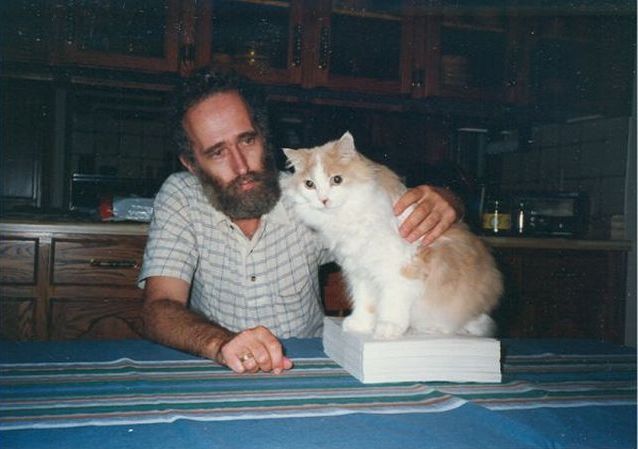
Acknowledgements: The last name in the fifth paragraph of the Acknowledgements is “Opus Ampersand (Ancaster)”, whose index entry (p. 449) reads “Ampersand, Opus: xiii”. Opus Ampersand was the name of Rapoport’s cat, whose biography follows:
Opus Ampersand, a.k.a. Opus &, b. May 10, 1976 in Edmonton; d. January 31, 1995 in Ancaster. KSS often sent greetings to her, as did Frank Holliday. Her biography:
EPUSSTLE
Ms. Ampersand learned purring and pouncing from her mother Ginger and brother Nutmeg before attending Kittygarten. Later she graduated from the University of the Catskills with a major in mewsic, having studied conduckting with Leopard Stokowski and self defense with Dame Myra Hiss.
Her least favourite music was Bless this Mouse, and A Mighty Fortress is our Dog by J. S. Bark, but she liked Magnificats, Tails of Hoffman, and the Scattish Symphony by Felix the Mendelssohn. Her prefurred composers were Paw Hindemith, Vincent Purrsicatti, Claw DePussy, and Lionpride Amadeus Meowzart. She explained that Byrd is an acquired taste.
At the age of 12, she won the famous Montreyowl competition by a whisker. In her spare time she learned languages (e.g. Siamese, Burmese, Russian Blue) and caught flies for the Detroit Tigers.
Dedications: The book has two dedications involving three people (p. [v]). The first one, to Frank Holliday and Norman P. Gentieu, reads “sine quibus non talis liber”, which translates as “without whom this book would not have existed”. The second one, to Nicolas Slonimsky, reads “sine quo non tale sæculum”, which means “without whom this century would not have existed” (in Rapoport’s words, Slonimsky was “a creator of the 20th century”).
Final inscription:
Deæ gratias maximas ac summas laudes, nam MCMXCII vere redactor
huius Opusculi Sorabjilibrarioli dactylographiam confecit,
domi suæ Ancastris, apud Canadenses bar-
barissimos et crapulosissimos.
[vide pp. 187, 191]
F i n e m
coronat
Opus
To the Goddess, greatest and highest praises {a parody of Sorabji’s words, with a nod to feminism, which he had no use for}, for indeed in 1992 the editor of this little work, a book about Sorabji, finished typing [it], at his house in Ancaster, amongst the most barbaric and crapulous Canadians.
Opus crowns the [book’s] end
{The references to pp. 187 and 191 are, respectively, to the transcription of the dedication of Opus clavicembalisticum (1929-30; 253 pp.) and to the triangular shape of Sorabji’s transcription in the score of the Symphony [no. 2], “Jāmī”, for Large Orchestra, Wordless Chorus, and Baritone Solo (1942-51; 826 pp.) of an excerpt from the epilogue of the traditional Arabic tale of the Queen of Sheba’s visit to Solomon in the translation by Joseph-Charles Mardrus.
“Finem coronat Opus” is an inversion of the well-known expression “Finis coronat Opus”, which means “The end crowns the work”. Rapoport writes: “In the photo below, she is doing just that; the pages are upside down. Moreover, I was determined to give her the last word in the book; in one of my earlier books, she gets the first word, because its title is Opus est [Opus est — Six Composers from Northern Europe: Matthijs Vermeulen, Vagn Holmboe, Havergal Brian, Allan Pettersson, Fartein Valen, Kaikhosru Shapurji Sorabji (London: Kahn & Averill, 1978; New York: Taplinger Publishing, 1979)].”}
2000: Sorabji Discussed in a Tiny Pub in a Remote Cotswold Village
The organist Kevin Bowyer published an article entitled “Twentieth Century European Organ Music — A Toast”, in The IAO Millenium Book, ed. Paul Hale (n.p.: Incorporated Association of Organists, 2000), 99-125, set as a conversation taking place in a small pub in a remote Cotswold village between a “Notorious Organist” and various characters (barman, Jocasta, Hugo, Albert, landlord). Sorabji is mentioned and/or discussed on pp. 100, 107-8, 118; p. 118 contains a musical example of the opening of the Symphony [no. 1] for Organ (1924; 81 pp.).
2003-: Sorabji’s Music Used in Choreographies
On 20 November 2003, no. 66 from the Études transcendantes (100) (1940-44; 456 pp.) was used together with music by György Kurtág, performed on stage by Frederik Ullén, in a choreography by Cristina Caprioli entitled Houses at the Dansens Hus in Stockholm. See Cecilia Blomberg, “Geometriskt utforskande på Dansens Hus Stora Scen” [Geometric exploration on Dansens Hus Stora Scen], Sveriges Radio, Kulturnytt i P1, 21 November 2003.
On 7 October 2011, var. 56 from the Symphonic Variations for Piano (1935-37; 484 pp.) was performed by Chappell Kingsland as partial music for Dear Frédéric by choreographer Dwight Rhoden by the Indiana University Ballet Theater, part of a production entitled Steps in Time.
On 14 December 2020 a choreography (performed in a private home) entitled Anxiety Dance by Gabriela S., as an illustration of graphic work by Nikodem Szewyczyk, was posted on YouTube (duration: 2:23) using no. 24 from the Études transcendantes (100) (1940-44; 456 pp.) using the recording by Fredrik Ullén (up to the barline on the second system of p. 155 in the published edition).
2004: Opus amorassissimo
Jed Distler (American composer), review of a recording (on eight CDs) of a recently discovered piano work of 6,969 pages entitled Opus amorassissimo [recte amorassissimum] en [recte in] tre atti, LXIX variationibus, cadenza, romanza e fuga (Ommaggio [sic] a Ronaldus Jeremici Stevensonicus), performed by Hugh G. Rackshawn on Altarus 412004(CD); published in Classics Today, 1 April 2004. For a related item, see the same author’s April Fools Godowsky Brahms C (no date given, but around April 2000) for an equally fictitious review of the four Brahms symphonies arranged for piano left hand by Godowsky and played by Geoffrey Douglas Madge.
2006: Fake Sorabji Comic Book Cover
On 7 October 2006 a “Johnny Heartbeat” uploaded an image showing the cover of a fake Sorabji comic book. It shows a drawing of Sorabji with his beringed left hand on his chin and the title “The Adventures of Sorabji / into the Clavicembalisticum!”. In the upper left corner is the title ”Archmagicomics”, which refers to the Sonata V (Opus archimagicum) (1934-35; 336 pp.).
2005-2008: Frank Rothkamm’s Opus Spongebobicum
Between 2005 and 2008 the German-born (Los Angeles–based) composer or [sic] conceptual artist Frank Holger Rothkamm wrote a piece for MIDI-fied piano (duration: 36:33) entitled Opus Spongebobicum or 40 Variations on the Secret Formula from Spongebob Squarepants xor 40 Veränderungen über die Geheimformel von SpongeBob Schwammkopf, the title of which is an acknowledged reference to Opus clavicembalisticum (1929-30; 253 pp.). The work has its own page on the artist’s website, and the cover of the Flux Records FLX9 recording features a large yellow sponge.
The music consists of 40 variations on the opening notes of the theme of the Nickelodeon animated television series “SpongeBob SquarePants” (1999-), the last variation being a recording of the needle playing the last grooves of a vinyl record. The 102-page score (2,155 bars, 15,919 notes) appears to be a transfer from the sound file to score notation (the link <http://rothkamm.com/pdf/rothkamm-Opus Spongebobicum-score.pdf> is no longer active). Quantization was not used, as evidenced by the many dotted short notes, the many ledger lines resulting from not using 8va lines, and the constant visual collisions between staves for the left and right hands.
The following list (divided into eight sections for visual convenience) shows the correspondence between variation number and initial bar number:
- 1 = 1, 2 = 22, 3 = 122, 4 = 182, 5 = 243
- 6 = 302, 7 = 372, 8 = 386, 9 = 426, 10 = 500
- 11 = 559, 12 = 602, 13 = 621, 14 = 681, 15 = 734
- 16 = 760, 17 = 798, 18 = 817, 19 = 919, 20 = 957
- 21 = 1027, 22 = 1092, 23 = 1148, 24 = 1207, 25 = 1235
- 26 = 1294, 27 = 1352, 28 = 1414, 29 = 1450, 30 = 1524
- 31 = 1571, 32 = 1691, 33 = 1755, 34 = 1811, 35 = 1817
- 36 = 1886, 37 = 1944, 38 = 2014, 39 = 2110, 40 = blank
2009: Opus clavicembalisticum Featured in Advertising
In February 2009 the Vicks company ran an advertising campaign on commercial radio for their cough drops in the United Kingdom for some three weeks, with Jonathan Powell playing from Sorabji’s Opus clavicembalisticum as background music. This was announced on the Sorabji Forum on 2 February 2009 by Alistair Hinton (And now for something completely different...) in the form of a riddle that sent members in search of the answer, based on Hinton’s suggestion that Sorabji often signed himself off in his letters as “Corfe Drop” (a play on Corfe Castle, his place of residence in later life).
2009: Sorabji Featured in Anthony Gormley’s One & Other
On 13 July 2009 at 11:00 p.m., Jim Penn, a frequent poster on the Sorabji Forum, took part in a public artwork by the British sculptor Anthony Gormley entitled One & Other, in which each of 2,400 selected volunteers spent one hour each day, twenty-four hours a day, on the empty Fourth Plinth in Trafalgar Square for a period of 100 days (6 July to 14 October 2009). The aim was to create an image of themselves and a representation of all of humanity. Penn announced his participation on the Sorabji Forum on 10 July 2009 and gave a brief report immediately after his allotted hour; while on the plinth he listened to Bach’s Passacaglia and Fugue in Helmut Walcha’s recording and to the final movement of Sorabji’s Symphony [no. 1] for Organ (1924; 81 pp.) in Kevin Bowyer’s recording. See also Penn’s page on the project’s website for an “About me” paragraph.
2012: Sorabji Featured as Background Music in a Documentary on Yoga
On 5 January 2012 a feature-length documentary entitled Breath of the Gods: A Journey to the Origins of Modern Yoga, by the German director Jan Schmidt-Garre, who has already produced several documentaries on music and musicians, has its theatrical release in Germany. A file available on YouTube uses the Pastiche on the Hindu Merchant’s Song from “Sadko” by Rimsky-Korsakov (1922; 4 pp.) played by Marc-André Hamelin as background music. Sorabji is mentioned by the director on page Filming (in) the Orient. Schmidt-Garre directed the DVD Marc-André Hamelin: No Limits, released as part of the series Legato: The World of the Piano (EuroArts 2055788; 2007).
2014: Opus clavicembalisticum Included in Lists of Piano Pieces
The English writer, journalist, and blogger Jessica Duchen proposed Opus clavicembalisticum (1929-30; 253 pp.) as the last title in a list of Top 20 Solo Piano Pieces on the Sinfini website (27 June 2014; website no longer in existence).
The Scottish writer Tom Service has included Opus clavicembalisticum (1929-30; 253 pp.) as the fifth title in his list of “10 favourite time-stretching musical masterpieces” in his article “10 of the best: long works” published in The Guardian for 31 December 2014.
2015: Mug Featuring Sorabji’ s Name
For a mug featuring the slogan “Keep calm and listen to Sorabji” under a crown, written in white capital letters on a red background, see Sean Vaughn Owen’s Facebook entry of 29 May 2015, where it is described as a gift from the composer Maurice Davies to Kevin Bowyer.
Late 2000s and After: Sorabji on Social Networking Websites
Sorabji pages can be found on MySpace (launched on 14 May 2008, with a presentation text in Italian) and Facebook (from the said page: “This Page is automatically generated based on what Facebook users are interested in, and not affiliated with or endorsed by anyone associated with the topic.”).
For a Facebook page with real content by one who has carried out comprehensive research in a university setting, see that put up by Sean Vaughn Owen (brief presentation). Sorabji-related photographs can be found at a Facebook link.
Performances and various items can be found on YouTube; see a list of available recordings on this resource.
No attempt is made on the Sorabji Resource Site to track sundry items posted on social networking websites.
Home | About | Recent Modifications | Site Map
Download Opus sorabjianum (version 4.00, 27 June 2023)
About
the Author | Contact
© Marc-André Roberge 2026
Faculté de musique, Université Laval, Québec
The contents of this website dedicated to the English composer Kaikhosru Shapurji Sorabji may be freely used for documentary purposes in a research context, provided that due credit is given, but may not be mirrored on any other server. Links to external or third-party websites are not guaranteed to be or remain valid or persistent and their content is not guaranteed to be or remain accurate or appropriate.